
RSL AUSTRALIA CALLS ON FEDERAL BUDGET TO FIX VETERAN HEALTHCARE INEQUALITY
MEDIA RELEASE
The Returned & Services League of Australia (RSL) is calling on the Federal Government to urgently address the growing disparity in veterans’ specialist healthcare payments in the 2026–27 Federal Budget, warning that outdated Department of Veterans’ Affairs (DVA) fee settings are causing wait times of up to nine months for specialist appointments and deterring practitioners from treating veterans.
RSL Australia National President, Peter Tinley AM, says the RSL’s 2026–27 Pre-Budget Submission outlined practical, targeted measures to ensure the momentum generated by the Royal Commission into Defence and Veteran Suicide translates into real and lasting outcomes for veterans and their families.
“Fair access to healthcare is not too much to ask. Our veterans and their families have sacrificed much in the service of our nation. But many are putting off seeing a doctor or accessing other health services because of increasing out-of-pocket costs and bureaucratic red tape,” Mr Tinley said.
Mr Tinley said the RSL has consistently warned that the growing barriers veterans and their families face in accessing timely healthcare, is exacerbated by a widening gap between inadequate DVA fees and the actual cost of services.
“This must be urgently addressed. The issue has been raised by the RSL on numerous occasions, including as one of five key policy asks presented to all parties and candidates contesting the most recent federal election and subsequently in our Pre-Budget submission.
“Despite some improvements in past Budgets, the current DVA fee schedule for medical services does not reflect contemporary healthcare costs and does not match that paid under the NDIS and other government programs.
“The widening gap between DVA fee payments and the actual cost of service provision is an increasing disincentive for healthcare providers to treat veterans. The issue is particularly problematic for psychiatrists and physiotherapists, many of whom have told us they are limiting their offerings to veterans because of the gap in DVA payments,” Mr Tinley said.
Practitioners in psychiatry, psychology and physiotherapy have reported that DVA fees do not meet market rates. The Royal Commission made clear that the effectiveness of veterans’ healthcare is limited by these outdated fees, with peak professional healthcare groups reporting that some practitioners have ceased or limited treatment of DVA patients.
Evidence from RSL members shows many veterans struggle to access necessary primary and specialist care, further exacerbating their health issues and burdening families. The barriers to veterans accessing healthcare are longstanding, having been identified in successive reports and inquiries including the Royal Commission.
“The situation is critical, with more clinicians predicted to cease treating DVA patients if funding does not increase. The barriers to obtaining services are particularly acute for the 45 per cent of veterans who live outside major metropolitan areas, intensifying the difficulty of accessing specialist care and services in rural and regional communities.”
Mr Tinley said it was incumbent on the Government to address these disparities as a matter of high priority to improve health outcomes for veterans and their families.
“This is an unacceptable situation that demands an urgent uplift of the DVA fee schedule in the forthcoming Budget to at least align with the NDIS rate framework,” Mr Tinley said.
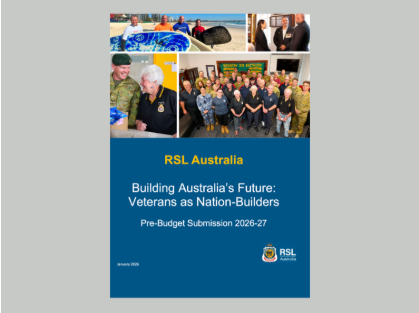
Read the RSL’s 2026-27 Pre-Budget Submission